
What does it cost?
A real number needs a look at the line, which is why there is no price table on this website. Two houses on the same street with the same slow drain can want a twenty-minute cable and a full mainline replacement, and the difference is invisible until a camera goes in. What you get instead is the number before the work: what it takes, what it costs, and what happens to the price if the camera turns up something worse further down.
Why does the same drain keep backing up?
Because something is holding it, and a cable went through that something rather than removing it. A cutting head bores a hole the width of itself through grease or a root mat; the fixture drains that afternoon and the line closes back up over the following weeks. That is the visit nobody should be paying for twice a year. A line with a history gets the camera and then the jetter, which strips the wall rather than punching through the middle of it.
Do I really need a camera inspection?
Not for a single slow lavatory. You do for anything that has come back, anything on the mainline, before you buy a property, and before you lay a floor or a drive over a run you have never seen. It is also the only honest basis for a repair quote: nobody here writes a number for digging or lining a line that has not been looked at. And you watch it live, on the monitor, standing next to it.
Can roots be stopped for good?
Cutting them out is an afternoon and they come back, because roots return to the opening they already found. What decides whether you see them again is whether anybody found that opening. The camera run after the cut shows the joint or the crack they came in at and how sound the pipe around it is, and then the options are a spot repair on one length, lining the run, or an honest maintenance interval. You will also be told when cutting again is just money spent on a delay.
Do you have to dig up my drive or my floor?
Sometimes, and sometimes not. Where the run is long, straight and structurally sound, it can be relined: a resin liner cured hard inside the old pipe, jointless, with the surface over the top left alone. Where the pipe has collapsed, separated, or bellied, it cannot. A liner follows the shape it is cured against, so a low spot stays a low spot. That call is made off the camera footage in front of you, before anyone quotes either method.
What actually breaks a sewer line in Los Angeles?
Age and materials, mostly. Cast iron scales up from the inside until the bore is a fraction of what it was, and it corrodes through at the bottom of the pipe where the water sits. Clay, which is what most laterals from before the 1970s are, opens at every mortar joint it has, and this county has very large street trees. Then there is ground movement, which bellies a run, and anything poured or driven over a shallow line.
You dug up the yard. What happens to it?
It goes back. Trenches are backfilled and compacted in lifts rather than tipped in loose, because a trench that settles takes the new slab or the lawn down with it. Concrete goes back, containment comes down, and the ground is left as close to how it was found as digging a hole in it allows. One of the reviews on this site is a customer saying the yard looked as if it had never been touched, and that is the standard the job is held to.
Do you work in occupied restaurants and apartment buildings?
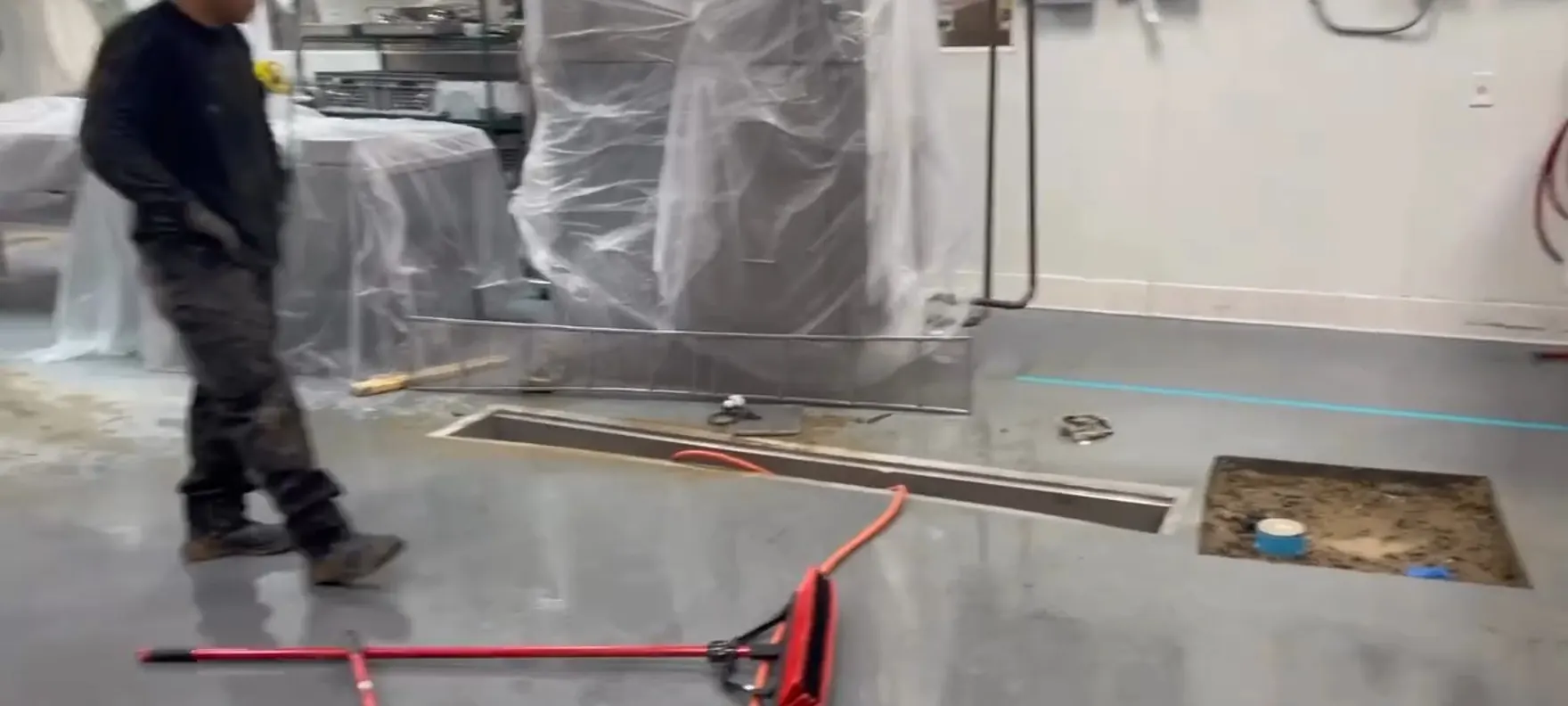
Yes, and it is a large part of the work. Containment goes up before the first cut: plastic floor to ceiling, equipment sheeted, and a route in and out that avoids anywhere in service. Kitchens and retail get worked nights and closed days where the job allows it. Owners and managers get the camera footage, because a repair on somebody else’s building has to be defensible to a board, a landlord or an insurer.
It is backing up right now. What do I do?
Stop using the line: no washer, no dishwasher, no shower on the affected side. A mainline with nowhere to go puts water out at the lowest opening in the building, usually a shower tray or a floor drain. Then call. The number on this site is answered around the clock. Text a photo of what you are looking at while you wait; it is worth more than a description.
Are you licensed?
Yes, and it is public record. California CSLB #1159169, classification C-36 Plumbing, current and active through 31 Aug 2028, held by Richard David Martinez, the same person who turns up. A $25,000 contractor's bond is on file with the state and there are no disciplinary actions on the record. You can read all of it yourself on cslb.ca.gov, and we would rather you did.
Book a visit
Still got one? Ask it here.
Anything about your own line is easiest answered standing over it with a camera. Send this and Ricky will call you back, or ring (213) 682-4466, which is answered at any hour.